

Here’s a scene we get called about constantly: it’s dinnertime, the microwave and the kettle are both going, and click, half the kitchen goes dark. Somebody heads down to the basement, flips the breaker back, and five minutes later it happens all over again. Annoying? Absolutely. But that breaker isn’t being difficult. It’s doing exactly what it was built to do, and it’s trying to tell you something. The trick is knowing when it’s a simple fix you can sort out yourself, and when it’s time to get a residential electrician in Brampton out to take a proper look.
So let’s get into it, plainly. Why breakers trip, what’s safe to poke at yourself, and the warning signs that mean you should stop flipping that switch and make a call.
A Breaker Tripping Is a Good Thing (Mostly)
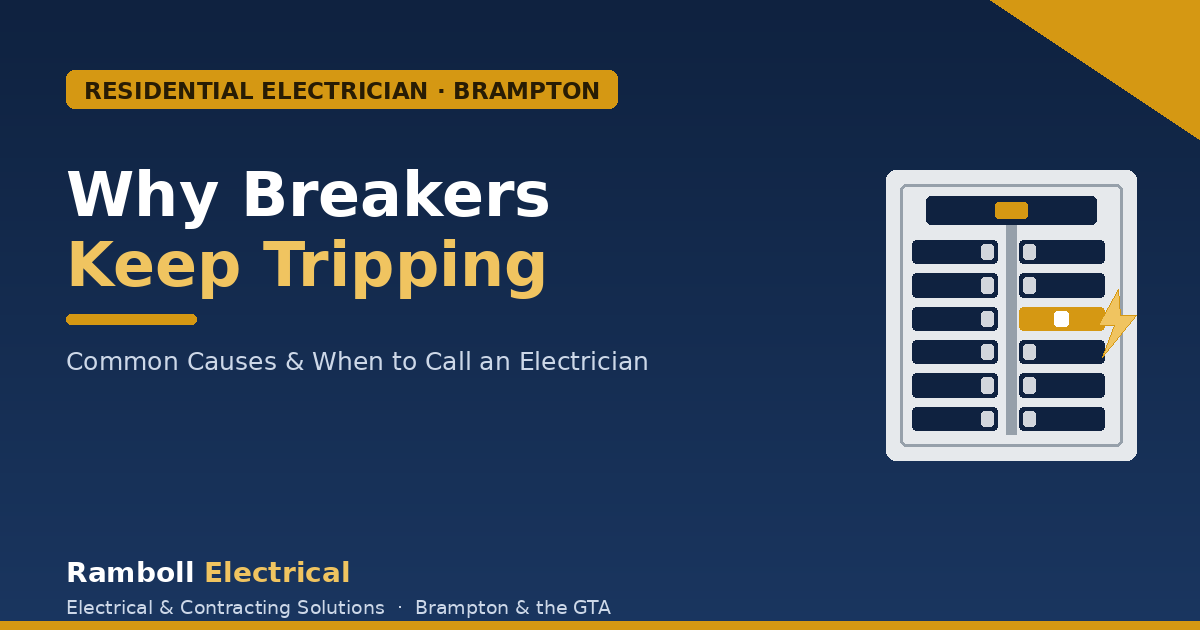
First, let’s clear up the biggest misunderstanding we run into. People treat a tripping breaker like it’s broken. It isn’t. A breaker has one job: the second a circuit pulls more power than it’s rated to handle, it kills the power, before the wires in your walls get hot enough to start a fire. Read that again. It’s a safety device that just saved you from an overheating wire. So the breaker isn’t the problem. It’s the smoke alarm going off. Our job, and yours, isn’t to shut the alarm up. It’s to figure out what’s setting it off.
So What’s Actually Causing It?
You’re asking one circuit to do too much
Nine times out of ten, this is it. Every circuit in your home has a limit, and a lot of older kitchens run way too much off a single one. Microwave, kettle, toaster, air fryer, all fired up together, and you’ve blown past what that circuit can carry. The giveaway is in the timing: it trips when you’re running a few hungry appliances at once, and behaves itself the moment you spread things out. That’s not a fault. That’s just physics catching up with your morning routine.
A short circuit
This is the serious one. A short is when a live wire makes contact with a neutral wire, and a big surge of current flows where it shouldn’t. The breaker slams off instantly to stop it. Shorts come from damaged wiring, a dodgy appliance, or trouble inside an outlet, and they’ll sometimes leave you a clue: a faint burning smell, or a scorch mark around a receptacle. If you’re seeing or smelling that, this is not a “watch a video and have a go” situation. Hands off and call someone.
A ground fault
Cousin of the short. Here the live wire touches a ground wire or the metal of the box. It loves moisture, which is the whole reason your bathrooms, kitchen counters, garage, and outdoor plugs are on GFCI protection, those outlets trip fast to keep you from getting a shock. A GFCI that keeps popping is usually crying about dampness somewhere, or an appliance plugged into it that’s on its way out.
Arc faults, if you’ve got a newer panel
Newer homes have AFCI breakers, and these are clever, they sniff out arcing, that tiny, sparking chatter that happens at a loose connection or a nicked wire. Arcing is a genuine fire starter, so if an AFCI keeps tripping, don’t write it off as fussy. It might be catching a real problem hiding in the wall.
One bad appliance
Sometimes the wiring’s perfectly fine and you’ve just got one sick appliance dragging everything down. A failing motor or a device shorting internally will trip the breaker every single time you switch it on. Easy to spot, really: if the trip always lines up with that one old space heater or that second-hand fridge, there’s your answer. Unplug it.
The breaker (or the whole panel) is just old
Breakers wear out like anything else. An old, tired one will start tripping at loads it used to shrug off. And an aging panel can develop loose connections and other gremlins that cause nuisance trips, sometimes worse. If your panel’s got a few decades on it, that alone is worth having a set of professional eyes on it.
What You Can Safely Try on Your Own
Before you call anyone, there’s some genuinely safe detective work you can do, no tools, and you never open the panel cover:
- See which breaker went and figure out what’s on that circuit. Half the answer is right there.
- Unplug a couple of things, then reset the breaker, once. Holds? You were overloading it. Mystery solved.
- Move the power-hungry stuff around. Shift the space heater or kettle to a different circuit and see if the trips stop.
- Hunt for the bad appliance. If one device sets it off every time, that device is the problem, not your house.
Now the part people get wrong, what NOT to do:
- Don’t sit there resetting a breaker that keeps popping. If it won’t stay on, it’s protecting you. Forcing it over and over is how wires overheat.
- Never swap in a bigger breaker to make the tripping stop. We can’t say this strongly enough. That strips out the protection your wiring relies on, and it’s a real fire risk.
- Never ignore a burning smell, warmth, buzzing, or scorch marks. That’s an emergency, not a quirk to live with.
- Don’t open the panel or start poking at wiring. That’s ours to handle, for good reason.
When It’s Time to Just Call Someone
Plenty of tripping is harmless, you overloaded a circuit, you back it off, done. But some of it isn’t, and these are the moments to stop troubleshooting and get a pro in for proper electrical troubleshooting:
- It trips the instant you reset it, or keeps going no matter what you unplug
- There’s a burning smell, scorch marks, or an outlet that’s gone brown
- The panel or an outlet feels warm, or you hear buzzing or see a spark
- A breaker flat-out won’t reset
- Several circuits are tripping, or it’s getting more frequent
- Your panel’s old and you’ve honestly no idea if it’s still up to the job
Any of these is a sign of something deeper, tired wiring, a failing panel, a fault hiding behind a wall, and it needs a real diagnosis, not another flip of the switch. A licensed electrician can track down what’s actually going on and handle the electrical repair services to put it right and back up to code, instead of just papering over it.
Why This Isn’t a DIY Job
We’re all for homeowners understanding their own place, that’s half the point of this article. But electrical is one of those lines you don’t want to cross on a weekend. The two risks, shock and fire, are the kind you don’t get a second try at. And beyond the danger, sloppy DIY wiring can bite you later: a failed inspection when you sell, or an insurance headache you never saw coming. A licensed, certified electrician has the training and the gear to find the true source of the tripping, fix it safely and to code, and leave you certain your home’s protected. For most home electrical problems, that’s not just the safer road. It’s the one that actually ends the problem for good.
Breaker Still Tripping? Let’s Sort It Properly.
Ramboll Electrical & Contracting Solutions does safe, certified electrical troubleshooting and repair across Brampton and the GTA. Skip the guesswork, get an electrician who’ll find the real cause the first time.
Frequently Asked Questions
Why does my circuit breaker keep tripping?
Usually it’s an overloaded circuit, too many power-hungry appliances going at once. But it can also be a short circuit, a ground fault, an arc fault, a failing appliance, or simply a worn-out breaker or an aging panel. If spreading out your appliances doesn’t settle it, or it trips the second you reset it, get a licensed electrician to diagnose it.
Is it dangerous if my breaker keeps tripping?
A one-off trip from an overload is harmless once you ease the load. What’s not harmless is repeated tripping paired with a burning smell, warmth, buzzing, or scorch marks, that can mean a short, arcing, or failing wiring, all genuine fire risks. Don’t keep resetting it; get it inspected.
Can’t I just put in a bigger breaker?
No, please don’t. Fitting a higher-amp breaker to stop the tripping is one of the most dangerous DIY “fixes” out there. The breaker is sized to protect the wiring in your walls, and a bigger one lets those wires carry more current than they’re rated for, which is exactly how electrical fires start. If a circuit genuinely needs more capacity, an electrician can add it safely.
How do I tell if it’s an appliance or my wiring?
Simple test: if the breaker trips every time you use one particular appliance, that appliance is almost certainly the cause, unplug it and have it checked. If it trips no matter what’s plugged in, goes instantly, or affects more than one circuit, the trouble is more likely in the wiring or panel, and that’s a job for a professional.
When should I call an electrician in Brampton?
Call one if the breaker trips repeatedly or instantly, won’t reset, or if you notice a burning smell, warmth, sparking, buzzing, or scorch marks, or if several circuits are going or your panel is old. Ramboll Electrical handles safe electrical troubleshooting and repair right across Brampton and the GTA.